

Water Energy Food Nexus (WEFN)
Water Energy Food Nexus (WEFN) Through Solar Green House Based Hydroponic Solutions
Water Energy Food Nexus (WEFN) Through Solar Green House Based Hydroponic Solutions with Android Mobile Application of Vegetable Market for Rural farmers and Urban Users’ is a major R&D project supported by the Department of Science and Technology (WTI/DST) under Water Energy Food Nexus call of the proposal. Uttarakhand State Council for Science and Technology (UCOST), Dehradun is a lead organization in this study with collaborators TERI-SAS, New Delhi, G. B. Pant University of Agriculture and Technology, Pantnagar, and DAV (PG) College, Dehradun.
The major objectives of this study were empirically linking Water Energy Food Nexus (WEFN) with experimental data in Dehradun Valley, Uttarakhand which includes inventory survey of crop information, energy consumption, evaluation of electricity and water pricing policy, its impact on cropping choice, field surveys to determine the type of high-value vegetable crops that should be encouraged for sustainable use of resources in the study area, and various stakeholder meetings in Doon valley for skill development of farmers. Another aim of this study was to assess cropping choice by developing an innovative Water-Energy-Food Nexus Index (WEFNI) and to optimize the most suitable crops for sustainable hydroponic farming, which also includes an Initial Model for calculating the index, Water Energy Food Nexus Index (WEFNI) of each high-value vegetable crop. One of the primary goals of this research is to evaluate cropping options by creating an innovative Water-Energy-Food Nexus Index (WEFNI) and to optimise the best crops for sustainable hydroponic farming. These activities aid in the optimization of crop patterns or the selection of high-value vegetable crops when using solar-powered hydroponic farming. These activities help in the optimization of cropping patterns or choice of high-value vegetable crops using Solar based hydroponic farming.
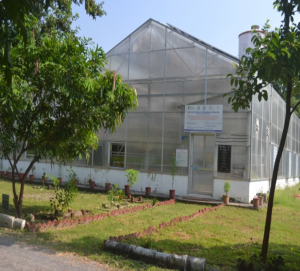
Under this project, a SMART Solar-based Hydroponic System having Automated Monitoring and controlling environmental parameters (temperature, humidity, pH, conductivity, etc) has been installed on Council’s premises. In this study, we have also developed an Android Mobile Application for Farmers which provides a link between transportation, storage, and markets of hydroponic and other crops. This Solar based Greenhouse system established at Council is one of the best greenhouse designs incorporating a source of renewable energy (solar energy) and monitoring and control of the internal greenhouse environment can be done through an automation unit. This study model can be replicated in other areas of the state as well as in the entire Himalayan ecosystem. Solar-based hydroponic farming will be helpful for better economic returns to the local farmers aiming to reduce their water and energy footprint. This is a State of Art lab-cum Solar Green House for Hydroponic production in Doon Valley, which is a technology demonstration-cum-dissemination centre and is beneficial for the Himalayan farmer’s community. It is a representative model of any small valley of Uttarakhand.
Achievements
Under the Water Energy Food (WEF) Nexus, optimization of water and energy consumptions for improved high value vegetable crops under solar based hydroponic system will be done to ensure a better economic return to the local farmers aiming to reduce water and energy footprint. A State of Art lab-cum Solar Green House for Hydroponic production in Doon valley, Uttarakhand for the Himalayan farmers’ community will be established to demonstrate and disseminate the technology.
Project Achievements So Far
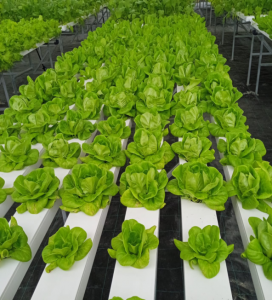
- A total of 6000 leafy vegetables and 100 cherry tomato plants are growing in NFT and Dutch bucket systems.
- A total of 9 species of leafy vegetables and one species of cherry tomato (Red Lollo Rosso, Green Lollo Rosso, Spinach, Parsley, Roman, Butterhead) are growing in the solar-based hydroponic system at UCOST.
- Forward market linkage was established in Dehradun Mandi.
- Development of a prototype mobile-based Android application.
- Inventory survey of crop information and stakeholder meetings in Dehradun valley.
- Monitoring and controlling environmental parameters like temperature, humidity, pH, conductivity, etc.
- Monitoring and controlling crop health on a daily basis.
- Comparative cultivation and biochemical analysis of lettuce & cherry tomato grown in soil, hydroponic system, and net house.
- Demonstration, dissemination, and promotion among local farmers, students, researchers, and entrepreneurs.
- Assessment of vegetable crop choices by local farmers and their water and energy consumption through grid-based energy.
- Analysis of energy and water consumption (Crop Water requirement) evolved through cropping patterns.
- Monitoring and control of the hydroponic system using machine learning algorithms, data processing, and device control.
Images